The Word Shaker
The Book ThiefThe Word Shaker is both a handmade book and Max Vandenburg’s central fable about language. Created for Liesel Meminger from painted pages of Mein Kampf, it recasts Adolf Hitler’s rise as the cultivation of forests of words and imagines Liesel as the one person capable of growing a rival tree. Its decisive significance lies in the reversal it performs: words, used by the Führer to organize obedience and persecution, become through Liesel a means of friendship, remembrance, and resistance.
Creation and Material Form
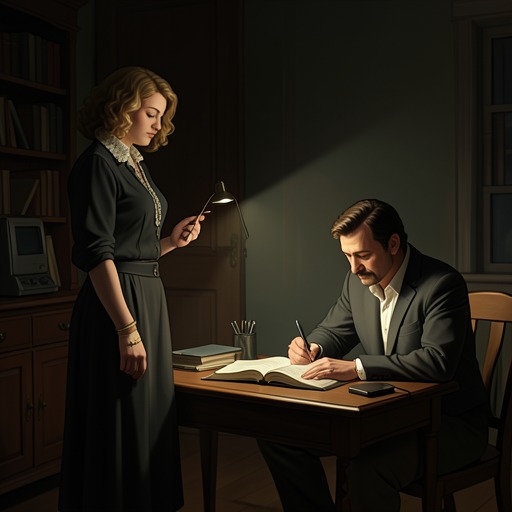
The book begins in confinement. During a week when Liesel was kept away from the basement, Max cut pages from Mein Kampf, painted over them in white, and hung them by pegs on a string from one end of the basement to the other. The repurposed pages preserve a material irony: the ideological text that helps sustain the regime is physically covered so that a different story can be written on it. Max planned the words in his head until he could recount them without error, then worked with a small black paintbrush on paper distorted by the drying paint.
Max expected failure. He calculated that he needed thirteen pages, so he painted forty, anticipating numerous mistakes. He practiced his rough drawings on pages from the Molching Express until the artwork reached a level he could accept. Liesel’s whispered observation that the man’s hair was like feathers entered the creative atmosphere around him, linking her perception to the book’s eventual imagery. When the pages were complete, Max pierced them with a knife and tied them together with string, producing a thirteen-page booklet titled The Standover Man.
The work did not remain fixed in that first form. After Liesel finished her first page, Max watched her and considered what he would eventually make from the painted surface. Many months later, he painted over the cover and gave the book a new title after one of the stories he would write and illustrate inside it. The finished object therefore carries several layers of transformation: Nazi propaganda becomes blank material, a first booklet becomes a larger collection, and Max’s private observation of Liesel becomes a fable addressed specifically to her.
From Air-Raid Reading to Fable
The Word Shaker grows directly out of Liesel’s reading during an air raid. After the sirens allowed people to return aboveground, Rosa Hubermann told Max about what had happened in the shelter, identifying the book Liesel had read as The Whistler. Max listened while Liesel stood in the basement, and the moment suggested to him a new body of work. He imagined the girl reading among frightened people as someone literally handing out words, while the shadow of Hitler and the approach of danger remained present behind the scene.
When Rosa finally gave Liesel the hidden sketchbook, she retrieved it from a sewn-up slit in the side of her mattress. She used a knife to open the concealed seam and handed over Max’s work, explaining that he had asked her to give it to Liesel when she was ready. Rosa had considered Liesel’s birthday and then Christmas, but concluded that Liesel had been ready from the moment she arrived at 33 Himmel Street clinging to the gate. The delivery turns the book into a delayed gift and a recognition of Liesel’s development from a frightened, illiterate child into a reader whose words can affect others.
The cover identifies the object as The Word Shaker, followed by the subtitle A Small Collection of Thoughts. Inside are thoughts, sketches, and dreams concerning Stuttgart, Germany, and the Führer, along with recollections of Max’s family. The fable therefore stands beside personal memory rather than replacing it. Max cannot exclude his family from the book, and the political allegory remains inseparable from the private history of the man who writes it.
Hitler’s Forest of Words
Max presents The Word Shaker as a fable or fairy tale, though Liesel cannot decide which; even after consulting the Duden Dictionary, she cannot distinguish the genres. A note before the story explains that Max almost crossed it out because he feared Liesel might be too old for such a tale, yet he also suggests that perhaps no one is too old for it. He has thought of Liesel, her books, and words, and the story has emerged from that association.
The tale begins with a strange, small man who chooses three defining details: he parts his hair against the prevailing fashion, makes himself a small, strange mustache, and intends one day to rule the world. The young man discovers the power of words after seeing a mother soothe a crying child. He realizes that words can alter conduct and feeling without physical force. The Führer consequently decides that he will rule through words and will not need to fire a gun.
His method is agricultural and industrial at once. He plants words throughout his homeland, cultivates them, and watches forests of farmed thoughts rise across Germany. The people are fitted with symbols, while demand for the regime’s ugly words and symbols increases. Word shakers climb the trees and throw the words down to those below, who consume them and return for more. The image describes propaganda as a system of production and distribution: language is grown, maintained, delivered, and absorbed until an entire population is organized by it.
The word shakers are not merely messengers. The best understand the true power of words and can therefore climb highest. One of them is a small, skinny girl, renowned in her region because she knows how powerless a person can be without words. Her hunger for language gives her unusual strength. The story makes literacy more than a practical skill: for Liesel, words are a form of access to the world, while their absence marks vulnerability and dependence.
Friendship Against the Axe
The girl’s political awakening is inseparable from a friendship. She meets a man despised by his homeland even though he was born there, and the two become good friends. When he falls ill, she lets a single tear fall on his face. That tear is made of friendship, described as a single word; it dries into a seed, which she plants among the other trees and waters each day.
At first the seed produces nothing. Then a sprout appears, and the tree grows faster than all the others until it becomes the tallest in the forest. The people gather to see it and wait for the Führer. Its height makes friendship visible within the landscape of ideological language. The tree is not produced by official cultivation or collective demand; it begins in a private act of care and grows beyond the scale of the words surrounding it.
The Führer orders the tree cut down. The word shaker pleads for it, but he refuses to make an exception and orders an axe. She breaks free, climbs the tree, and remains in its highest branches while the Führer strikes the trunk. The axe beats continue as clouds pass like white monsters with gray hearts, but the tree will not move. Even when another man is ordered to continue the work, the trunk withstands the assault.
At the summit, the girl encounters the man whose illness prompted the seed. He confirms that the seed came from his cheek, and together they remain among the branches until the clouds disappear. She explains that the tree would not stop growing; he answers that neither would the branch holding his hand. Their exchange preserves the fable’s double movement: friendship creates the tree, but the tree also creates a place where friendship can endure. The regime can command an axe, yet it cannot make the living thing stop growing.
Return to Liesel and Narrative Meaning
The fable’s images return to the main story when Liesel encounters Max again among Jewish prisoners being marched toward Dachau. This time she does not reach out to him. She stops, and the souls of words rise inside her and stand beside her. She addresses him by recalling the opening of Max’s story, beginning with the strange, small man, and then adds that there was a word shaker too. A Jewish prisoner stops walking, while the others move around him, and the words pass from the girl to the Jew.
The scene gives the fable a physical afterlife. Max’s words, first written in hiding on painted pages, become Liesel’s spoken means of recognizing him in public danger. The story’s distinction between Hitler’s words and the word shaker’s words is enacted rather than merely explained: language can mark, manipulate, and persecute, but it can also cross the distance between a German girl and a Jewish man whom the state has declared an enemy.
The Word Shaker also becomes part of the larger survival of the book thief’s story. Near the end, the black book is described as disintegrating under the weight of travel, while repeated words are linked to memory and endurance. The physical object decays, but its language continues to return—in Max’s fable, in Liesel’s reading, and in her later recognition of Max. Its lasting force does not come from permanence as an object. It comes from repetition, transmission, and the choice to use words against the power that first claimed them.